
Premium Bonds prize rate hits 15-year high, but are they worth it?

There are now more chances to win through Premium Bonds as the prize rate reaches a 15-year high. So, what are your odds of becoming a millionaire overnight and are they worth it? Read on to find out.

Premium Bonds were first introduced in 1956 to encourage more people to save. They’re issued by National Savings and Investments (NS&I) and backed by the government. However, they’re different to traditional savings accounts or bonds.

While Premium Bonds offer an “interest rate” of 3.3% as of March 2023, it’s not paid in the same way as a savings account.

Instead, each bond is entered into a prize draw each month, with ERNIE (the Electronic Random Number Indicator Equipment) selecting the winners. It means you could win up to £1 million, but on the flip side, your savings may not earn anything at all.

You can buy Premium Bonds for just £25 up to a maximum of £50,000. Each bond you hold has 24,000 to 1 odds of winning, with prizes ranging from £25 to £1 million.

You can also purchase Premium Bonds on behalf of children.

Premium Bonds have proved a popular way to save. In fact, more than 22 million people have more than £119 billion saved in them.

So, should you make Premium Bonds part of your financial plan? As with any financial opportunity, there are pros and cons, and whether it’s right for you will depend on your goals.

4 reasons why people use Premium Bonds to save

1. You could become a millionaire!

One of the biggest draws of Premium Bonds is the chance to become a millionaire overnight – each month two Premium Bond holders win £1 million. Everyone loves the idea of winning big, so it’s easy to see why Premium Bonds are attractive to some people.

2. Your savings are risk-free

HM Treasury backs Premium Bonds, so there’s no risk of losing the money you use to buy them. As a result, Premium Bonds could fit into your overall financial plan.

This point used to be key, but since the introduction of the Financial Services Compensation Scheme (FSCS), all UK savings are protected up to £85,000 per person, per institution the savings are held with.

3. Your money is instantly accessible

You can withdraw money held in Premium Bonds instantly, without facing any charges. So, if you’re saving for short-term goals or building up an emergency fund, Premium Bonds could be a useful option to consider.

4. The prizes are tax-free

If you’re lucky enough to win a prize through Premium Bonds, the money is tax-free.

If you don’t have the maximum £50,000 in Premium Bonds, there’s an option to automatically purchase more to increase your chances of winning again in the future. 

2 key drawbacks you need to know before using Premium Bonds

1. There’s no guarantee that you’ll win

With a traditional savings account, you know how much interest you’ll receive on your deposits. This isn’t the case with Premium Bonds – if you’re unlucky, you could go years without winning.

In fact, according to Money Saving Expert, around 60% of people that hold £1,000 in Premium Bonds don’t win a prize at all each year. 

You need to weigh the excitement of potentially winning big against the reality that you could receive far less than you would if you place the money in a savings account.

2. Your money could be losing value when you consider inflation

While your money is secure in Premium Bonds, once you consider inflation, the value could be falling in real terms.

This is because the prizes you win are unlikely to keep pace with inflation. So, over the long term, your savings will gradually buy less. This isn’t just an issue for Premium Bonds, but something most people that are holding money in cash need to consider.

If you’re saving with long-term goals in mind, investing could help your savings grow at a pace that matches or exceeds inflation. However, investing comes with risks and you cannot guarantee returns. As a result, you’ll need to consider what your risk profile is and whether investing is right for your goals.

If you have questions about how Premium Bonds could fit into your financial plan and support other steps you are taking, please contact us. We’ll help you understand if Premium Bonds could be appropriate for you, as well as look at the alternatives.

Please note: This blog is for general information only and does not constitute advice. The information is aimed at retail clients only.

The value of your investment can go down as well as up and you may not get back the full amount you invested. Past performance is not a reliable indicator of future performance.
5 inaccurate expert predictions that prove why you shouldn’t try to time the market

When you look at investment performance with the benefit of hindsight, you may think you could predict how markets will move. Yet, markets are unpredictable and expert forecasts prove how difficult timing the market is.

Every investor has heard the advice “buy low, sell high”. So, it can be tempting to try and guess how investments will perform in the short term to make the most of your money. But history shows us that trying to time the market is impossible.

Even experts who have far more resources at their disposal sometimes get it wrong, so trying to predict the market and economy could mean you miss out. Here are five examples of when expert predictions completely missed their mark.

1. 1929: The market has reached a “permanently high plateau”

Irving Fisher is considered one of America’s greatest mathematical economists. But his name is still linked to a major incorrect prediction – in 1929, he claimed that stock markets had reached a “permanently high plateau”.

Just nine days later, the “Great Crash” occurred and led to the collapse of the New York Stock Exchange. In a single day (29 October 1929), investors traded some 16 million shares, making it the largest sell-off of shares in US history and investors lost billions of dollars. The crash signalled the start of the Great Depression.

2. 1995: The internet will “catastrophically collapse”

When you’re considering investing in new industries, expert advice can be invaluable. However, basing your investment strategy on predictions could mean you miss out on opportunities.

In 1995, Robert Metcalfe, the co-inventor of the Ethernet, gave a magazine interview where he said the internet would “soon go spectacularly supernova” and in 1996 “catastrophically collapse”. He was so confident, he promised to eat his words if he was wrong. 

Of course, almost three decades later, we know that wasn’t the case. The internet has become an integral part of everyday life and business operations. Metcalfe stuck to his word though – he blended the magazine and literally ate his words in front of a live audience.

3. 1999: Stock values will soar fourfold

Just before the turn of the millennium, two experts, James Glassman and Kevin Hassett, published a book that claimed stocks in 1999 were significantly undervalued. As a result, investors could benefit from a huge rise in value over the next few years, they said.

In fact, they predicted the value of stocks would increase fourfold and the Dow Jones Industrial Average would increase to 36,000 by 2002 or 2004.

Just two years later, the dotcom bubble meant the stock market fell sharply. Other factors, including the 2008 financial crisis, meant that the Dow didn’t reach the 36,000 milestone until 2021. 

4. 2007: The subprime mortgage market troubles are “largely contained”

Many investors will remember the effects of the 2008 financial crisis, which was partly caused by the subprime mortgage market in the US. Looking back, it can seem like all the signs of impending trouble were there, yet many experts failed to connect the dots.

Former US treasury secretary Hank Paulson said the subprime mortgage market would be “largely contained” and he didn’t see it causing a “serious problem” in 2007. He wasn’t the only expert to downplay the risks either. Others agreed, and some even suggested that it presented an opportunity.

The problem turned out to be far-reaching – it triggered a global recession, markets fell in value, and governments had to bail out financial institutions.

5. 2021: Inflation will peak at around 5%

As it considered the lasting effects of the Covid-19 pandemic in November 2021, the Bank of England (BoE) predicted that inflation would be around 5% in spring 2022 and that the period of high inflation would be temporary.

Just months later, the war in Ukraine meant that oil and gas prices were much higher than anticipated. Other factors also affected the cost of living, which was high for much of 2022. Inflation reached 11.1% in the 12 months to October 2022 and remained well above the BoE’s 2% target at the start of 2023.

How time in the market could help you overcome volatility

The five examples above highlight how difficult it is to time the market. While you may base your prediction on information available at the time, there are so many factors that could affect how the market moves that are outside of your control. As a result, trying to time the market could mean you miss out on growth opportunities.

For most investors, a long-term investment strategy focused on time in the market makes sense. Rather than buying and selling frequently, creating a portfolio that reflects your goals and risk profile could help you build long-term growth. While markets do fall, and so can the value of your investments, historically, markets have recovered from dips and delivered growth over a longer time frame.

It can be difficult to ignore the noise when you’re investing and you may be tempted to make changes. However, looking at the value of your investments over years, rather than days or weeks, is important. Remember, time in the market, rather than timing the market, could deliver long-term value.

If you have any questions about your investment strategy or which opportunities could be right for you, please get in touch.

Please note: This blog is for general information only and does not constitute advice. The information is aimed at retail clients only.

The value of your investment can go down as well as up and you may not get back the full amount you invested. Past performance is not a reliable indicator of future performance.

Soaring inflation drives up retirement costs by almost 20% in just a year

High inflation means retirees could need to increase their budget by almost 20% to maintain the same lifestyle, research suggests. If you’re drawing an income from your pension, it’s vital you understand whether withdrawing more is sustainable.

The UK experienced high inflation throughout much of 2022, and inflation remains above the Bank of England’s target of 2%. This has stretched many household budgets, but retirees may find it more difficult to weather a period of high inflation.

As your income may not increase, or you deplete assets more quickly, you could face more financial uncertainty later in life.

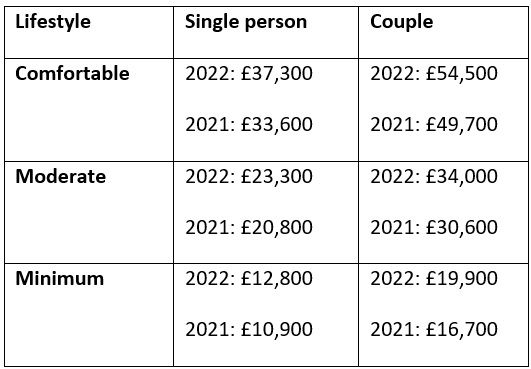
A retired couple needs an annual income of £34,000 for a “moderate” lifestyle

The Pensions and Lifetime Savings Association (PLSA) has updated its Retirement Living Standards to reflect recent high inflation. It found that some retirees will need to increase their budget by 19% just to maintain the same standard of living they enjoyed at the start of 2022.

The organisation noted that people that retired with a lower income have seen the biggest percentage increase because a higher proportion of their budget goes towards areas that have risen the most, such as food and energy.

The PLSA research sets out the annual income retirees may need to secure a “minimum”, “moderate”, or “comfortable” lifestyle.

The “minimum” lifestyle covers things retirees need to live a fulfilling life, including social and cultural participation. For a couple, this includes £96 a week for grocery shopping, a week-long break in the UK, and affordable leisure activities twice a week. It also considers things like maintaining a property.

In the space of just a year, the cost of a minimum lifestyle has increased by 19% for a couple.

The “comfortable” lifestyle budget includes more luxuries, such as running two cars and three weeks visiting Europe each year.

For a two-person household, the cost of this lifestyle has increased by 10% in the last year.

The table below shows the PLSA’s estimated income needs for each lifestyle and how the period of high inflation has affected budgets.

Keep in mind that these figures are a useful indicator of retirement costs, but your outgoings will depend on your lifestyle. However, it does highlight why reviewing your pension and income is so important.

If you’ve already retired, you should look at whether you could use your assets to boost your income, while being mindful of ensuring you don’t run out of money during your lifetime.

4 things to consider if you’re reviewing your retirement income

If high inflation means you need to review your retirement income, these four questions could help you understand your options.

1. How much have your outgoings increased?

First, take some time to look at how your expenses have changed in the last year. While the official inflation figures can be useful, your personal inflation rate may be very different. It will depend on how you spend your money and your priorities. So, going through your budget could help you identify a potential shortfall.

2. What reliable income do you have?

In retirement, you may have several sources that you can rely on to pay an income for the rest of your life. This may include the State Pension, an annuity, or a defined benefit (DB) pension.

In some cases, the income provided will rise in line with inflation to protect your spending power. For example, the State Pension will rise by a record 10.1% in April 2023. As a result, your income gap may not be as large as you first think.

3. What other assets could you use to increase your income?

Next, review your other assets that could provide an income in retirement. This could include a flexible income from a defined contribution (DC) pension. You may also have other assets you could use, such as investments, savings, or property.

Reviewing these assets could help you bridge a potential gap if inflation means you’re facing a shortfall.

4. Could you sustainably increase your income?

Remember to look at your overall financial plan and consider the long term when making decisions.

While other assets could boost your income, don’t forget to consider whether using these assets is sustainable over the long term.

So, while you could increase how much you withdraw from your DC pension, could it mean you run out of money later in life? And how would taking an income from investments affect your portfolio’s performance?

Contact us to create a retirement plan

As financial planners, we can work with you to create a retirement plan that suits you. We’ll consider what type of lifestyle you want throughout retirement and how you could use your assets to help you achieve it. We’ll also factor in potential risks, such as a period of high inflation, so you can have peace of mind about your retirement finances.

Please note: This blog is for general information only and does not constitute advice. The information is aimed at retail clients only.

A pension is a long-term investment not normally accessible until 55 (57 from April 2028). The fund value may fluctuate and can go down, which would have an impact on the level of pension benefits available. Past performance is not a reliable indicator of future results.

The tax implications of pension withdrawals will be based on your individual circumstances. Thresholds, percentage rates and tax legislation may change in subsequent Finance Acts. 

5 practical things to check as part of a financial midlife MOT

Rishi Sunak is reportedly drawing up plans to provide a “midlife MOT” to assess the financial health of workers and retirees. Taking stock of your finances in your 40s and 50s could lead to greater financial freedom in the future. Read on to discover five initial steps you can take to review your wealth.

Sunak’s plans are focused on encouraging people to get back to work as employment figures are still not back to the levels they were before the Covid-19 pandemic. Early retirees that gave up work during the pandemic are now feared to be hampering the UK’s economic recovery.

There are also concerns that some early retirees made the decision based on assumptions about their finances before the cost of living crisis. Over the last year, inflation has been high and it could mean some retirees face a financial shortfall now or in the future.

While Sunak’s plans are designed to encourage more people to join the workforce, a midlife MOT can be useful for keeping your plans on track.

Your mid years are often crucial for building wealth that could mean you are financially secure in the future. So, taking stock now is a worthwhile task.

Here are five areas you should cover in your financial midlife MOT.  

1.  Review outstanding debt

Reducing your expenses as you near retirement could provide far more financial freedom. One key way of doing this is to create a plan to reduce outstanding debt.

One of the largest debts you have is likely to be your mortgage. If you can, a plan to own your home outright when you retire can significantly reduce the income you need. Paying off credit cards or loans could also boost your disposable income in the future.

Having debt, including a mortgage, doesn’t mean you can’t retire, but you should factor repayments into your budget when assessing the income you need.

2.  Assess your savings

Spend some time assessing your savings and understand if they would provide a safety net if you faced a financial shock, like an unexpected property maintenance bill or being unable to work due to an illness.

Having savings to fall back on when you need them can provide vital financial security now and in the long term. It means you could weather financial shocks and you don’t have to dip into other assets that you earmarked for other goals.

As the Bank of England has increased interest rates, it’s worth shopping around to see if you’re getting the most out of your money.

3. Look at your investment portfolio

Regularly reviewing your investment portfolio can help you understand how it’s performing – remember to review returns with a long-term view, rather than focusing on how the value of investments have changed over weeks or months.

It’s also a good opportunity to ensure your portfolio continues to reflect your goals. Changes to your circumstances or aspirations could mean adjustments to your investments make sense.

If investing isn’t something you’re already doing, it could help you reach long-term goals.

While investing does involve risk and the value of investments can fall, historically, markets have delivered returns over longer time frames. So, if you’re saving for a goal that is more than five years away, investing could grow your wealth and help your assets keep pace with inflation.

When you invest, it’s essential you consider the level of risk that’s appropriate for you and your circumstances.

4. Set out your retirement plans

When you think about retirement planning, it may be finances and pensions that come to mind. However, when and how you want to retire are crucial pieces of information if you’re to create a reliable retirement plan.

Set out what your retirement plans are – do you want to phase into retirement by working part-time? Or are you hoping to retire early?

You should also consider what you want your lifestyle to look like when you give up work. This can be useful for understanding the income you need your pension and other assets to deliver to reach your goal.

5. Check if you’re on track to reach your pension goal

With a clearer understanding of your retirement plans, you can review your pension – are you on track to have enough to live the retirement lifestyle you want?

It can be difficult to understand how the value of your pension will change between now and retirement, and what the value needs to be to provide financial security. As well as considering what contributions you’ll make, you may also need to consider things like investment returns. So, working with a financial planner here can be valuable.

Going through your pension now could uncover potential gaps and provide an opportunity to fill them.

A financial review can help you take stock of where your finances are now and the steps you could take to reach your goals. Please contact us to arrange a meeting.

Please note: This blog is for general information only and does not constitute advice. The information is aimed at retail clients only.

The value of your investment can go down as well as up and you may not get back the full amount you invested. Past performance is not a reliable indicator of future performance.

A pension is a long-term investment not normally accessible until 55 (57 from April 2028). The value of your investments (and any income from them) can go down as well as up, which would have an impact on the level of pension benefits available.

Your pension income could also be affected by the interest rates at the time you take your benefits. The tax implications of pension withdrawals will be based on your individual circumstances. Levels, bases of and reliefs from taxation may change in subsequent Finance Acts. 

Investment market update: February 2023

Statistics suggest that some of the pressures facing economies, such as high inflation and recession concerns, are starting to ease. However, there is still a risk that economies could fall into a recession in 2023. Read on to find out what influenced the markets in February 2023.

As an investor, remember to focus on your long-term goals when making decisions. Volatility is part of investing, and you should ensure that any investment matches your risk profile.

UK

Official figures for the end of 2022 meant the year started with some good news – the UK narrowly avoided a recession.

GDP in December declined by 0.5%, but this was offset by gains in the previous two months. A technical recession means an economy has contracted for two consecutive quarters. As the UK economy contracted in the third quarter of 2022, there was a recession risk. Investors should still be prepared for volatility though, as economists are predicting a recession this year.

The Bank of England (BoE) also believes the UK will face a recession, although it expects it to be shallower and shorter than previously forecast. The BoE predicts economic output will fall, from peak to trough, by less than 1%. This compares to more than 6% during the 2008 financial crisis and 3% during the 1990 recession.

After a year of high inflation, it is starting to ease and fell to 10.1% in January. The figure is still much higher than the BoE’s 2% target, so it’s not surprising the central bank increased the base interest rate to tackle the rising cost of living.

The BoE’s Monetary Policy Committee voted to increase rates from 3.5% to 4% – a 14-year high – and cautiously said it believed the peak of inflation was now behind us.

One of the key factors continuing to drive inflation is high energy prices. So, energy firms announcing huge profits has led to criticism and calls for further windfall taxes. In February:

  • Oil giant Shell reported earnings of almost $40 billion (£33.2 billion).

  • BP posted record profits of almost $28 billion (£23.2 billion).

  • The owner of British Gas, Centrica, reported its profits tripled to more than £3 billion.

The cost of living crisis has led to nationwide industrial action. The Office for National Statistics found that more than 840,000 working days were lost due to strike action in December. During February professionals from teachers to Border Force staff participated in strikes.

There could be some good news for workers struggling because of the rising cost of living. Research from the Chartered Institute of Personnel Development found that 55% of recruiters plan to lift pay this year to improve staff retention and hiring.

Data suggests that many businesses are still facing challenges:

  • The S&P purchasing managers’ index (PMI) for the manufacturing sector found it has contracted in the six consecutive months to January. However, the pace of the downturn slowed when compared to December.

  • The UK service sector suffered its worst month in terms of output in two years as both consumers and businesses cut back their spending.

  • Figures from the Insolvency Service show insolvencies jumped 7% year-on-year in January. When compared to the start of 2020, just before the pandemic hit, insolvencies are 11% higher.

Despite reports showing there are still obstacles ahead, the FTSE 100 reached record highs during the month. At the start of the month, it surpassed the previous record set in May 2018, which was then beaten several times during the next few weeks.

Europe

Similar to the UK, the European economy narrowly avoided a technical recession at the end of 2022. The European Commission (EC) expects the final growth figure for 2022 to be 3.5%.

An S&P Global report also indicates the eurozone economy grew for the first time since June 2022 in January. The reading lends weight to the hope the bloc could avoid a recession as companies report higher levels of business activity.

Looking to the year ahead, the EC expects Ireland to lead the recovery. The country is forecast to grow by 4.9% in 2023 following last year’s estimated annual growth of 12.2%, which made it the fastest-growing economy in Europe.

In contrast, Germany, which is often deemed the powerhouse of the EU, could face challenges. Signs suggest the country could fall into a recession after industrial output fell by 3.9% in December. This fall is linked to high energy prices, with output from energy-intensive industries falling by 6.1%.

Inflation remains a key challenge in the eurozone, but, again, it is easing.

In January inflation was 8.5%, down from 9.2% a month earlier, according to Eurostat. High energy costs, which increased by 17.2%, are still driving the rate of inflation.

After increasing interest rates by 50 basis points, the European Central Bank said it will “stay the course in raising interest rates significantly at a steady pace”. So, households and businesses should expect further rises throughout 2023.

US

The US also beat recession fears after GDP increased by 2.9% in the final quarter of 2022.

However, the PMI data indicates businesses are still facing headwinds. Output declined at the start of 2023, driven by a sharp contraction in new orders and subdued sales from both domestic and export markets.

Despite this, job figures indicate businesses are feeling optimistic. The US job market added 517,000 jobs in January, far surpassing the 185,000 economists predicted.

Like Europe, inflation is slowing in the US. The cost of living increased by 6.4% in January.

Please note: This blog is for general information only and does not constitute advice. The information is aimed at retail clients only.

The value of your investment can go down as well as up and you may not get back the full amount you invested. Past performance is not a reliable indicator of future performance.

Your guide to pension consolidation: The pros and cons you need to know

Do you have multiple pensions? It could make it difficult to manage your pension savings during your working life and when you retire. In some cases, consolidating them could be beneficial.

This guide explains what you need to know about transferring your pension savings, so you have fewer pots to manage. It could help you feel more in control of your retirement and, in some cases, reduce the amount you’re paying in fees.

However, there are reasons why consolidating your pension may not be right for you:

  • You have a defined benefit pension

  • Your pension has additional benefits

  • You may need to pay an exit fee

  • You could benefit from using “small pot” privileges.

Download “Your guide to pension consolidation: The pros and cons you need to know” now to read more about pension consolidation and understand if it could be the right decision for you.

If you have any questions about your pension or retirement, please get in touch.

The essential guide to ISAs

ISAs have been around for more than two decades, but they’ve changed significantly since they were first introduced. This guide can help you understand why using an ISA to save or invest could be a valuable part of your financial plan.

Read the guide to find out:

  • Why ISAs are a tax-efficient way to save and invest

  • Discover the different types of ISA you can choose from

  • What you should consider when deciding if you should save or invest through an ISA

  • How Junior ISAs could help you build a nest egg for children or grandchildren

  • How you could leave your ISA to loved ones when you pass away.

Download your copy of “The essential guide to ISAs” to understand why around 12 million adults contribute to their ISAs each year.

If you have any questions about the topics covered in the guide, please contact us. We can help you manage your savings and investments in a way that reflects your goals, including ISAs if they’re appropriate for you.

McLaren Market Insights January 2023

McLaren Insights

Investors should expect further volatility in the markets in 2023, experts suggest.

Economies around the world are facing recession due to factors including high inflation and rising interest rates. The International Monetary Fund’s Kristalina Georgieva predicts that a third of the global economy will be in recession this year.

 The World Bank also has a similar outlook, as it cut its global growth forecast from 3% to 1.7% after risks identified six months ago materialised. The organisation warned that fresh setbacks could lead to the second global recession in three years.

As an investor, remember that volatility in the markets is normal. Take a long-term view of your portfolio’s performance and focus on your overall goals rather than short-term market movements.

Here are some of the factors that affected markets in January 2023.


UK Financial News

There was a positive sign that the UK could avoid the long recession that some experts have predicted – the economy grew by 0.1% in November.

The UK inflation rate also dipped slightly to 10.5% in the 12 months to December. It suggests that inflation is starting to ease, but it’s still far higher than the Bank of England’s (BoE) target of 2%. However, the BoE’s chief economist Huw Pill warned that the UK could face persistent challenges if domestically generated inflation gained momentum. For example, if firms try to maintain real profit margins, it could prolong the high inflation environment.

High energy prices in particular continue to be a challenge for both households and businesses. Chancellor Jeremy Hunt will slash the current energy support scheme for businesses in March. He told business leaders that the current scheme is “unsustainably expensive”. Trade body MakeUK, which represents around 20,000 manufacturers, criticised the news. It warned that two-thirds of businesses expect to cut production or jobs as a result of energy prices.

The UK government’s borrowing reached a record high in December, which highlights the cost of the energy support scheme. The government borrowed £27.4 billion, the highest amount recorded since records began in 1993. The high figure was linked to the cost of energy and interest rates rising. The figure was £9.8 billion more than the Office for Budget Responsibility forecast, potentially leaving little room for Hunt to cut taxes in the upcoming spring Budget. 

According to the Office for National Statistics (ONS), industrial action also affected firms, with a quarter of businesses said they were unable to obtain the necessary goods for their operations during the month. The ONS data suggests that some businesses plan to make cuts to their staff in the next three months. 5% say they could make redundancies, while two-thirds plan to take action to cut staff costs. Yet, the figures also show that a third of businesses are experiencing a shortage of workers.

Readings from the S&P Global Purchasing Managers’ Index (PMI) indicate that sectors are struggling. A reading below 50 indicates contraction.

  • The manufacturing sector ended 2022 in a downturn, with a reading of 45.3. It’s the fifth consecutive month of decline.

  • A fall in new orders affected the service sector, but only marginally, with a reading of 49.4.

The ONS has warned that some households could face a significant rise in their outgoings. In 2023, 1.4 million fixed-rate mortgage deals will end, and many of them have an interest rate below 2%. As interest rates climbed throughout 2022, this means homeowners could face a much larger mortgage bill than they expect when their current deal ends.

Figures from the BoE also show that consumers are borrowing more to cope with the rising cost of living. £1.5 billion was borrowed in November. Most of this, around £1.2 billion, was on credit cards and was the highest figure recorded since 2004.


European Financial News

Inflation in Europe could be stabilising. In Germany, the figure for the 12 months to December 2022 fell to 8.6% from 10% a month earlier. However, food prices (20.7%) and energy costs (24.4%) are still much higher than a year ago.

The PMI data suggests the construction sector in the eurozone is suffering a “sustained contraction” after the reading fell to 42.6. All three of the largest economies the survey covers in the eurozone – Germany, France, and Italy – suffered a drop.

Total output is still in the contraction territory, but it is easing with a reading of 49.3, and the service sector moved back into growth with a reading of 50.2.

While still challenging, the pressure easing is reflected in a survey from the Ifo Institute. It found that German business morale is up as the economic outlook improves.

Unemployment figures from the eurozone also indicate that businesses are feeling confident about their prospects. Eurostat reported that unemployment remained at a record low of 6.5% in November.


US Financial News

There are positive signs for the US economy – inflation fell and the number of jobs increased. In the 12 months to December 2022, US inflation fell to 6.5%. It indicates that the cost of living pressures are starting to ease. The US job market ended 2022 on a high. The Department of Labor reported that 223,000 jobs were added to the economy at the end of the year. Unemployment also fell to 3.5%, taking it to its pre-pandemic low. Yet, some businesses are still struggling. The PMI for the factory sector suggests it suffered its fastest rate of decline since May 2020, with a reading of 46.2.

Unsure about your investment portfolio? Why don’t you get in touch with one of our financial advisers for a consultation on us.

Would you like to receive McLaren’s monthly market insights directly to your inbox? Sign up below.